
We Are Not the Sector You Turn to Last

by Mariane Asad Doyle, Ph.D., Chief Executive Officer, Center for Nonprofit Excellence
This spring, I sat with a Virginia nonprofit leader who had just lost a federal grant that funded a third of her organization's budget. She was not panicking about her own paycheck. She was doing math on how many fewer families her food pantry could serve and calling board members to ask who might know a local funder willing to bridge the gap. That conversation is playing out across Virginia and the country right now, and it says something important about how we talk about nonprofits: not as charity operating on the margins, but as economic infrastructure that communities depend on to function.
The data backs this up. In 2024, the nonprofit sector contributed more than $1.5 trillion to the U.S. economy, over 5% of GDP (Independent Sector, 2025). Nonprofits employed 12.8 million people in 2022, 9.9% of the private workforce, making the sector the country's third-largest employer, just ahead of every branch of manufacturing (U.S. Bureau of Labor Statistics, 2024; Newhouse & Abramson, 2025). That is not a rounding error in the American economy. That is a workforce nearly the size of California's, doing work that businesses and government cannot or will not do.
Yet when budgets tighten or political priorities shift, nonprofits are too often treated as the first line item to cut rather than a sector whose stability matters to everyone else's. That instinct gets the story backward. Research from the Urban Institute found that roughly one in three U.S. nonprofits experienced a government funding disruption in just the first half of 2025, through lost grants, funding freezes, or stop-work orders (Tomasko et al., 2025). The nonprofits hit hardest relied on government dollars for 42% of their revenue, well above the sector average (Tomasko et al., 2025). Those disruptions do not stay contained inside nonprofit budgets. They show up as longer waits at food pantries, fewer counseling appointments, and slower disaster response, right when communities need those services most.
History tells us nonprofits often do the opposite of what recessions do to the rest of the economy. During the Great Recession, Maryland's nonprofit employment grew 2.7% in 2008 while for-profit employment fell 3.3% (Johns Hopkins University Gazette, 2010). We do not retreat when times get hard. We are often the sector standing between a community and collapse.
Here in Virginia, that pattern holds. The Center for Nonprofit Excellence's 2026 economic impact report, produced with the University of Virginia School of Data Science, found that the Commonwealth is home to more than 43,000 charitable nonprofits, employing nearly 388,000 people and generating close to $80 billion in annual revenue (Center for Nonprofit Excellence & University of Virginia School of Data Science, 2026). Virginia's food banks alone distributed 175 million pounds of groceries in 2024 (Center for Nonprofit Excellence & University of Virginia School of Data Science, 2026). That is not a sector operating at the edges of civic life. That is infrastructure, as essential to the Commonwealth as our highways or our hospitals and it deserves to be recognized, resourced and represented with the same seriousness we give to business, healthcare, and education.
That recognition does not happen by accident. It happens when nonprofits organize, share data, and speak with one voice, and when funders and policymakers invest in the organizations doing that work. At CNE, that is our job: to champion Virginia's nonprofits, build the evidence base that proves our economic weight, and advocate for policies, like the health insurance pooling legislation we helped pass this year, that strengthen the whole sector rather than one organization at a time.
If you lead a Virginia nonprofit, I hope you will consider joining CNE. You will be part of a network of more than 2,400 organizations building collective strength, rather than facing hard times alone. And if you are a funder, I would ask you to think about investing not just in individual grantees, but in the backbone infrastructure, organizations like CNE, that make the entire sector stronger, more resilient, and better equipped to weather whatever comes next.
Nonprofits are not the sector you turn to when everything else has failed. We are the sector that keeps showing up, in good times and hard ones. It is time our seat at the table reflected that.
References
Center for Nonprofit Excellence, & University of Virginia School of Data Science. (2026, February 5). The Center for Nonprofit Excellence & UVA School of Data Science release 2026 economic impact of the nonprofit sector report [Press release]. https://thecne.org/2026/02/18/33376/
Independent Sector. (2025, December). Health of the U.S. nonprofit sector: 2025 annual review. https://independentsector.org/wp-content/uploads/2025/12/Health-of-the-U.S.-Nonprofit-Sector-Report-2025.pdf
Johns Hopkins University Gazette. (2010, January 11). Study: Nonprofit job growth in Maryland defies recession. https://gazette.jhu.edu/2010/01/11/study-nonprofit-job-growth-in-maryland-defies-recession
Newhouse, C. L., & Abramson, A. J. (2025, July). Nonprofit employment in the states, 2017-2022 (Briefing #3). George Mason University Nonprofit Employment Data Project, Center on Nonprofits, Philanthropy, and Social Enterprise. https://nonprofitcenter.schar.gmu.edu/wp-content/uploads/2025/07/GMU-NED-Briefing-3_FINAL.pdf
Tomasko, L., Martin, H., Fallon, K., Kim, M., Faulk, L., & Boris, E. T. (2025). How government funding disruptions affected nonprofits in early 2025: Nationally representative findings from the Nonprofit Trends and Impacts Study. Urban Institute. https://www.urban.org/research/publication/how-government-funding-disruptions-affected-nonprofits-early-2025
U.S. Bureau of Labor Statistics. (2024, December). Nonprofits accounted for 12.8 million jobs, 9.9 percent of private-sector employment in 2022 [The Economics Daily]. https://www.bls.gov/opub/ted/2024/nonprofits-accounted-for-12-8-million-jobs-9-9-percent-of-private-sector-employment-in-2022.htm

At a time when nonprofit workforce burnout is high and experienced leaders are nearing transition, the nonprofit leadership pipeline needs attention. Add to that the unique challenge of population shifts in Eastern North Carolina...


Our defense of philanthropic freedom is about more than our members. It’s also about preserving an environment where we can respond to challenges in inspiring and meaningful ways – and support our communities when they need it the most.

For 10 years, South Carolina's first Medical Legal Partnership has shown how legal aid can improve health outcomes by addressing housing, income, benefits and other issues that often keep patients from getting better.

To be an effective manager, you need both management skills and leadership qualities. These are the capabilities that make your job easier, increase employee accountability, and create a better workplace for everyone.

Transformational collaborations come from a commitment to seeing a project through from both sides. These partnerships are the ones that change things- that produce impact- the ones genuinely invested in the outcome- not just the output.
We Are Not the Sector You Turn to Last
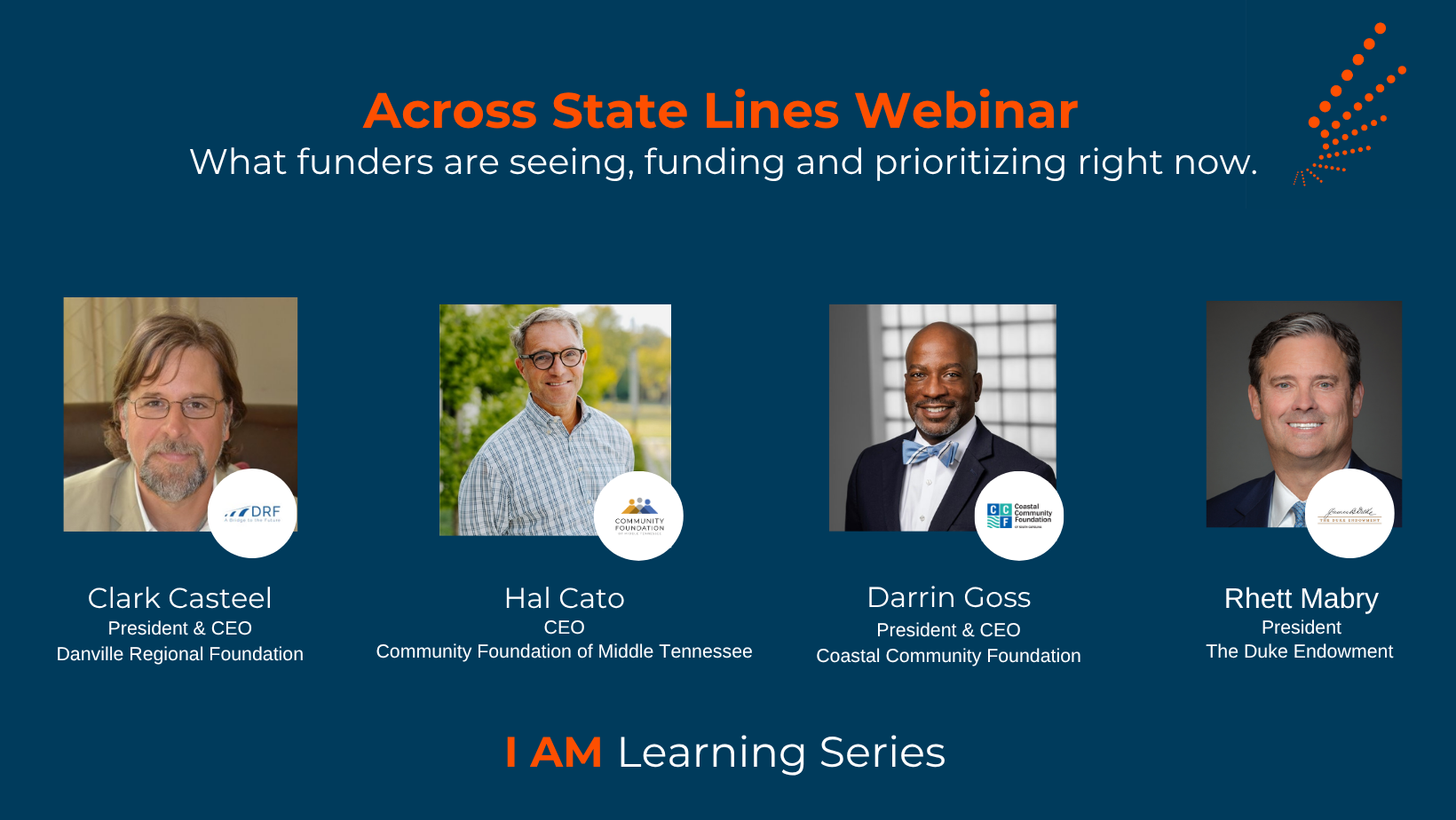
Across State Lines What Funders Are Seeing, Prioritizing and Funding Right Now

Building Ponds: Lessons from a Few Dump Trucks and Four Funders
Succession Planning is the Beginning, not the End. Who Will Lead Next?
Staying Connected
Complete the form below to receive the latest updates, events, and insights.
Ready to Partner